
If you’re thinking already about what kinds of gifts to give for Christmas this year, have you considered unity? There is nothing more expensive (or needed) than unity.
Think of the newlyweds who are daily working out their marriage, constantly forgiving, recommunicating, trying to see and hear the best in each other, while learning to share everything that they had previously held as their own.
Think of the parents, teachers, pastors and caregivers, raising little humans with the tension of meeting their needs and maintaining honesty and safety, while also trying to form them into whole, morally upright, capable adults.
Think of the church, bringing together people from every tribe, tongue, nation, gender, demographic, socioeconomic background and weekly navigating the challenges of life, worship and mission together.
Unity, though fundamentally a gift from God, requires constant grace, effort, and expense to maintain. Just look at how it was experienced by the early church:
“They sold property and possessions to give to anyone who had need” (Acts 2:45).
“No one claimed that any of their possessions was their own, but they shared everything they had…and God’s grace was so powerfully at work in them all that there were no needy persons among them” (Acts 4:32-37).
This was not the outcome of a reformed system of government or a billionaire’s utopian dream. It was sacrificial, Spirit-empowered living by ordinary people. In both passages, these radical acts of unity-building immediately, continuously flow out of the outpouring of the Holy Spirit. The greatest evidence of the Spirit’s outpouring is unity.
We do not have the resources in and of ourselves to generate or maintain any semblance of real unity. It is impossible. And yet, Paul can write to a fledgling family of believers at Philippi:
“Make my joy complete by being like-minded, having the same love, being one in spirit and of one mind. Do nothing out of selfish ambition or vain conceit. Rather, in humility value others above yourselves, not looking to your own interests but each of you to the interests of the others. In your relationships with one another, have the same mindset as Christ Jesus” (Philippians 2:2-5).
Then Paul tells the story that contains the secret to unity. It is the only way that any person, cohort or institution could possibly live up to what he has asked. It is, of course, the story of the costly incarnation of the Son of God.
“Who being in very nature God, did not consider equality with God something to be used to his own advantage; rather, he made himself nothing by taking the very nature of a servant, being made in human likeness. And being found in appearance as a man, he humbled himself by becoming obedient to death – even death on a cross!” (Philippians 2:6-8).
The pursuit of unity is not achievable just by following Christ’s example. We need His Spirit inside of us, Christ living in and through us, to work it out. If you want to truly experience the power of the Spirit and the depth of what it means to need the Father and be near to Christ, I commend to you the pursuit of unity.
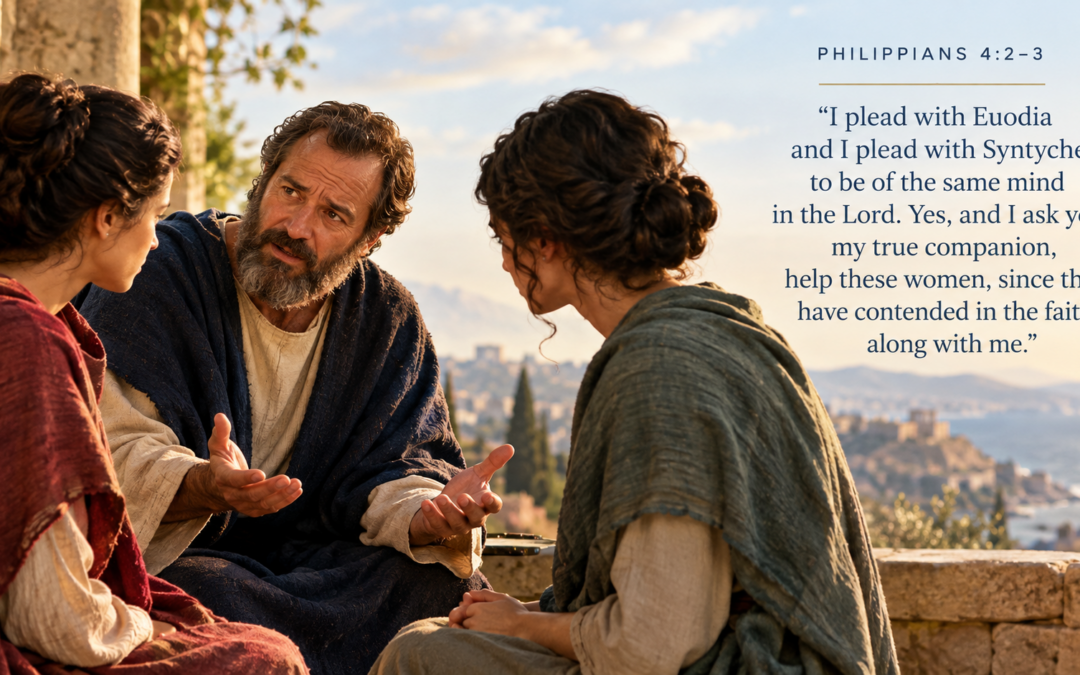
After writing or reciting this profound poem/hymn in chapter 2, Paul gets far more personal and practical in chapter 4: “I plead with Euodia and I plead with Syntyche to be of the same mind in the Lord.” We have no idea what happened or has come between them, but isn’t it just too relatable? And isn’t it amazing that the same scriptures are just as concerned with an individual relationship in the church as they are with the story of the incarnation?
We will never get to practice putting aside power, glory and authority on the scale that Jesus did. Our daily act of costly unity looks far more like Euodia’s or Syntache’s. If I could plead with you for a moment as Paul did, here are some very challenging, very worthy unifying acts to practice:
Make time to talk to someone at church who is very different from you. Don’t just shake their hand. Really take an interest in who they are.
The next time you find yourself in a conversation with a difference of perspective, take a moment to really, charitably consider their point of view as though they are good, rational, reasonable (and, for bonus points, that you might be wrong).
Make a small act of giving that rebels against the inequity of someone else’s situation. You don’t have to sell home or land, but maybe that monetary gift to someone struggling would mean more than the accumulation of another thing.
Let’s pray together for the generosity to live lives shaped by the power and story of the incarnation: “Comeunity.”
Recent Comments